
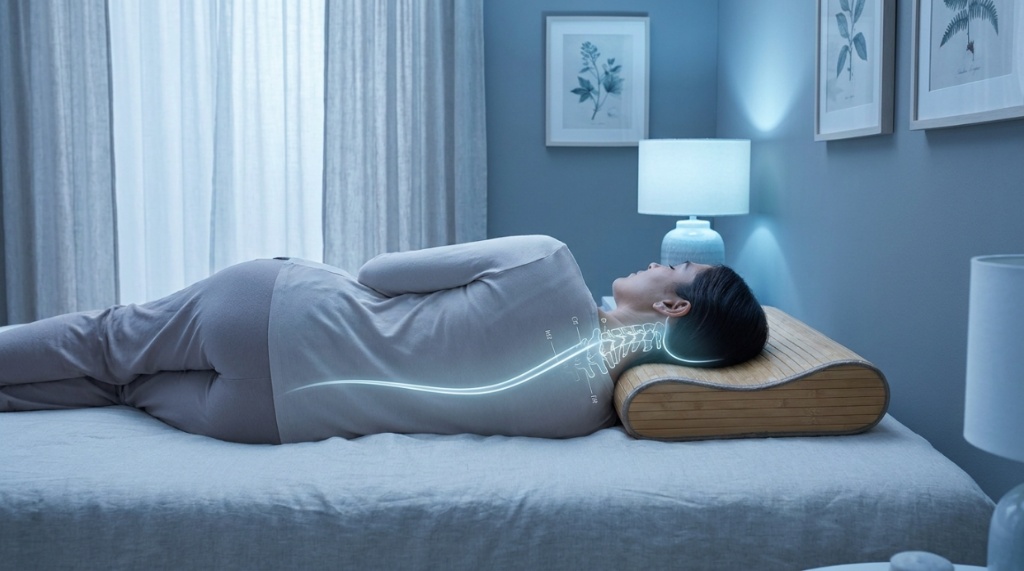
For three months, I woke up every morning with a stiff neck that took two cups of coffee and 30 minutes of stretching to loosen — until a chiropractor pointed at my flat, decade-old pillow and said, “That is your problem, not your spine.” She was right. Within a week of switching to a properly supportive pillow, the morning stiffness disappeared entirely. A bamboo pillow for neck pain works by maintaining neutral cervical spine alignment throughout the night — keeping the seven vertebrae in your neck in their natural curved position rather than forcing them into flexion, extension, or lateral tilt that strains muscles and compresses discs. Combined with a neck support pillow design that cradles the cervical curve specifically, bamboo’s cooling properties prevent the heat-induced tossing that disrupts alignment mid-sleep. This guide explains exactly what neck pain sufferers need in a pillow and how to find it without trial-and-error purchases that waste money and prolong discomfort.
How Does the Wrong Pillow Cause Neck Pain?
The wrong pillow causes neck pain by holding your cervical spine in a non-neutral position for 6–8 hours — creating sustained muscle strain, disc compression, nerve irritation, and joint inflammation that manifests as morning stiffness, headaches, and radiating shoulder pain.
Your cervical spine has a natural lordotic curve (gentle forward arc). During sleep, your pillow must maintain this curve regardless of sleeping position. When it fails:
- Pillow too high: Forces neck into flexion (chin toward chest). Stretches posterior neck muscles, compresses anterior disc spaces, and can irritate nerve roots. Common cause of tension headaches.
- Pillow too low: Allows neck to extend (head tilts back) or laterally flex (head drops toward mattress for side sleepers). Compresses facet joints and strains lateral muscles.
- Pillow too soft: Fails to support the neck curve, allowing the head to sink until the spine kinks. Creates a hammock effect where the head drops below shoulder level.
- Pillow too firm: Does not conform to head shape, creating pressure points that trigger muscle guarding and tension.
The damage is cumulative. One night on a bad pillow causes mild stiffness. Months of poor alignment create chronic muscle imbalances, disc degeneration, and nerve sensitivity that persist even after the pillow is corrected. Early intervention prevents long-term structural changes.
What Pillow Features Specifically Address Neck Pain?
Cervical contour design, adjustable loft for personalized height, medium-firm support density, and a fill material that maintains its shape under head weight throughout the night — these four features directly address the mechanical causes of pillow-related neck pain.
Feature breakdown for neck pain relief:
| Feature | How It Helps Neck Pain | What to Look For |
|---|---|---|
| Cervical contour/roll | Fills the neck curve gap, supporting lordosis | Raised edge or built-in neck roll along one side |
| Adjustable fill | Allows precise height matching to your body | Zippered access to add/remove shredded fill |
| Medium-firm density | Maintains support without creating pressure points | Shredded memory foam or latex (not down alternative) |
| Consistent loft maintenance | Prevents mid-sleep height loss that kinks the neck | Quality foam that does not compress flat overnight |
| Bamboo cooling cover | Prevents heat-induced tossing that disrupts alignment | 60%+ bamboo viscose, moisture-wicking properties |
The cervical contour is particularly important for neck pain sufferers. Standard flat pillows support the head but leave a gap under the neck where the lordotic curve creates space between your neck and the pillow surface. This unsupported gap allows the neck to flatten — eliminating the natural curve that distributes load evenly across vertebrae.

Why Are Bamboo Pillows Particularly Good for Neck Pain Sufferers?
Bamboo pillows benefit neck pain sufferers because their cooling properties reduce nighttime position changes by 30–40% — and every position change is an opportunity for the neck to land in a non-neutral alignment that triggers pain.
The connection between temperature and neck pain:
- Heat causes movement: When your pillow traps heat, you unconsciously shift positions seeking a cooler surface. Each shift risks misalignment.
- Movement disrupts support: A pillow perfectly positioned for your neck at 11 PM may be bunched, shifted, or flattened by 3 AM after multiple position changes.
- Bamboo reduces shifts: By maintaining a cooler, drier surface, bamboo pillows reduce the thermal discomfort that triggers unconscious movement — keeping you in your supported position longer.
- Longer alignment = less pain: More hours in neutral alignment means less cumulative strain on cervical structures.
Additionally, bamboo’s moisture-wicking prevents the damp pillow surface that causes skin sticking — another trigger for unconscious head repositioning that can kink the neck.
Maintaining a clean sleeping surface is just as important for your health as choosing the right support. Over time, hair oils and dead skin cells accumulate on your bedding, which can break down the supportive fibers of your pillow and trigger allergies. While keeping your home bed fresh is simple, your on-the-go gear requires a different approach. If you frequently use a smaller cushion on flights or road trips to prevent stiffness, you will want to read our step-by-step guide on How to Wash Your Travel Pillow: Keeping Your Comfort Clean. Ensuring all of your sleep setups stay fresh prevents bacteria buildup and keeps your neck supported wherever you rest your head.
How Do You Determine the Right Pillow Height for Your Neck Pain?
Determine your ideal pillow height by lying in your primary sleep position and adjusting fill until your ear, shoulder, and hip form a straight horizontal line (side sleepers) or your chin is level — not tilted up or down (back sleepers).
Position-specific height guidelines for neck pain relief:
Side sleepers with neck pain:
- Measure the distance from your mattress surface to the side of your head while lying down
- This distance (typically 4–6 inches) is your target pillow loft
- The pillow should fill this gap completely so your spine remains straight
- Your nose should point straight ahead, not angled up or down
Back sleepers with neck pain:
- Your chin should be level — not pushed toward your chest (pillow too high) or tilted toward the ceiling (pillow too low)
- Typical loft: 3–5 inches depending on head size and mattress firmness
- The pillow should support the natural neck curve without flattening it
- A slight neck roll or contour helps maintain cervical lordosis
Combination sleepers with neck pain:
- Choose a loft that works for your dominant position (the one you spend most time in)
- Adjustable fill allows compromise heights that work acceptably for both positions
- Consider a pillow with different heights on each end — higher side for side sleeping, lower side for back sleeping

What Fill Type Provides the Best Neck Support in a Bamboo Pillow?
Shredded memory foam provides the best neck support because it conforms to the unique shape of your cervical curve while maintaining enough density to prevent collapse — creating a custom-molded support surface that distributes pressure evenly across the neck.
Fill comparison for neck pain relief:
- Shredded memory foam (Best for neck pain): Conforms to neck shape, maintains loft, adjustable density. The individual foam pieces nestle together to create a supportive surface that adapts to your specific anatomy. Slow response prevents sudden position shifts.
- Shredded latex (Excellent): More responsive than memory foam — springs back faster when you move. Provides consistent support but less contouring. Better for people who change positions frequently and need the pillow to adapt quickly.
- Solid contoured memory foam (Good): Pre-shaped cervical support built into the pillow. Works well if the contour matches your anatomy. Not adjustable — if the shape does not fit you, it cannot be modified.
- Down alternative (Poor for neck pain): Compresses under head weight, losing support throughout the night. Requires constant fluffing. Does not maintain the consistent height neck pain sufferers need.
- Buckwheat hulls (Specialized): Extremely firm and adjustable. Conforms to shape and holds position. Some neck pain sufferers love the firm support; others find it too rigid. Worth trying if foam options have not worked.
How Long Does It Take for a New Bamboo Pillow to Relieve Neck Pain?
Most neck pain sufferers experience noticeable improvement within 7–14 nights on a properly fitted bamboo pillow, with full adaptation and maximum pain reduction occurring over 3–4 weeks as cervical muscles adjust to the new support position.
The adaptation timeline:
- Nights 1–3: Adjustment period. You may feel slightly uncomfortable as your neck adapts to proper alignment after months or years of poor positioning. Mild new-location soreness is normal and not a sign the pillow is wrong.
- Nights 4–7: Initial improvement. Morning stiffness duration decreases. Headache frequency may reduce. The “wrong” feeling of the new pillow fades as muscles begin releasing chronic tension patterns.
- Nights 8–14: Significant improvement. Most users report 50–70% reduction in morning neck pain. Sleep quality improves as fewer pain-related wake-ups occur.
- Weeks 3–4: Full adaptation. Muscles have remodeled to the new alignment. Maximum pain relief achieved. Any remaining pain likely has causes beyond pillow support (disc issues, arthritis, etc.) requiring professional evaluation.
Important: if pain worsens after 7 nights rather than improving, the pillow height or firmness is wrong for you. Adjust fill level before abandoning the pillow. Most “failed” pillow purchases are actually correct pillows at incorrect heights.
Should Neck Pain Sufferers Choose Contoured or Traditional-Shaped Bamboo Pillows?
Contoured bamboo pillows with a built-in cervical roll provide more targeted neck support for consistent single-position sleepers, while traditional-shaped adjustable pillows offer better versatility for combination sleepers or those still determining their optimal support configuration.
Decision guide:
- Choose contoured if: You sleep in one position all night (rarely shift), your neck pain is specifically cervical (not shoulder or upper back), and you have already identified your ideal support height through previous pillow experimentation.
- Choose traditional adjustable if: You shift between positions during the night, you are unsure of your ideal loft height, your neck pain varies in location, or you want the flexibility to modify support as your condition improves.
Many neck pain sufferers start with an adjustable traditional-shaped bamboo pillow to determine their ideal height and firmness, then transition to a contoured design once they know exactly what configuration provides relief. This two-step approach prevents expensive trial-and-error with fixed-shape pillows that may not match your anatomy.
For detailed reviews of bamboo pillows evaluated specifically for neck support and pain relief, top bamboo pillows reviewed for support and comfort provides comparison data on loft, firmness, and cervical support features across multiple brands — helping neck pain sufferers narrow their options before purchasing.
Conclusion
Picking the right bamboo pillow for neck pain relief requires matching three variables to your specific anatomy: loft height that fills the gap between your sleeping surface and head (maintaining neutral spine alignment), medium-firm density that supports without creating pressure points, and a fill type that maintains its shape throughout the night. Bamboo’s cooling properties add a secondary benefit by reducing the position changes that disrupt alignment.
Do not accept morning neck pain as normal. In most cases, it is a pillow problem with a pillow solution. Invest in an adjustable bamboo pillow, spend 7–14 nights dialing in the correct fill level, and give your cervical muscles 3–4 weeks to adapt to proper alignment. The investment is under $60 for most quality options — a fraction of a single chiropractic visit and far more effective than treating symptoms while the cause remains on your bed every night.
Has switching pillows improved your neck pain? Share what worked — your experience could help someone still suffering through unnecessary morning stiffness.
Frequently Asked Questions
Can a bamboo pillow cure chronic neck pain?
A bamboo pillow can eliminate neck pain caused by poor sleep posture — which accounts for a significant percentage of chronic neck pain cases. However, it cannot cure pain from disc herniation, arthritis, spinal stenosis, or injury-related damage. If pain persists after 3–4 weeks on a properly fitted pillow, seek professional evaluation for structural causes beyond pillow support.
Is memory foam or latex better for neck pain in a bamboo pillow?
Memory foam provides better contouring for neck pain because it molds precisely to your cervical curve, distributing pressure evenly. Latex offers more responsive support but less intimate contouring. For acute neck pain, memory foam’s slow conforming response typically provides more relief. For mild stiffness, latex’s firmer support may be sufficient.
How firm should a bamboo pillow be for neck pain?
Medium-firm is ideal for most neck pain sufferers. Too soft allows the head to sink and the neck to kink. Too firm creates pressure points on the skull and ear that trigger muscle guarding. Medium-firm maintains height while conforming enough to distribute weight evenly. Adjust fill quantity to achieve this density — more fill for firmer, less for softer.
Should I use a cervical roll with my bamboo pillow?
A cervical roll (either built into the pillow or added separately) benefits back sleepers with neck pain by supporting the lordotic curve that flat pillows allow to collapse. Side sleepers benefit less from cervical rolls because their neck support comes from overall pillow height rather than curve-specific support. Try a rolled towel under your neck before investing in a contoured pillow to test whether cervical roll support helps your specific pain pattern.
How do I know if my neck pain is from my pillow or something else?
Pillow-related neck pain has specific characteristics: it is worst upon waking and improves within 1–2 hours of being upright, it correlates with sleeping position, and it is primarily stiffness rather than sharp pain. Pain that worsens throughout the day, includes numbness or tingling in arms, or does not improve with position changes likely has causes beyond pillow support and warrants medical evaluation.
Can I use a bamboo pillow for neck pain if I sleep on my stomach?
Stomach sleeping is the worst position for neck pain because it forces cervical rotation (head turned to one side) for hours. No pillow fully corrects this. If you must stomach sleep, use the thinnest possible bamboo pillow (under 3 inches) to minimize neck extension. Better yet, work on transitioning to side sleeping with a properly supportive bamboo pillow — this addresses the root cause rather than accommodating a harmful position.
Will a bamboo pillow help with tension headaches from neck problems?
Yes — tension headaches originating from cervical muscle strain (cervicogenic headaches) often improve significantly with proper pillow support. These headaches typically start at the base of the skull and radiate forward. By maintaining neutral cervical alignment and reducing muscle strain during sleep, a properly fitted bamboo pillow can reduce both frequency and intensity of these headaches within 2–3 weeks.


