

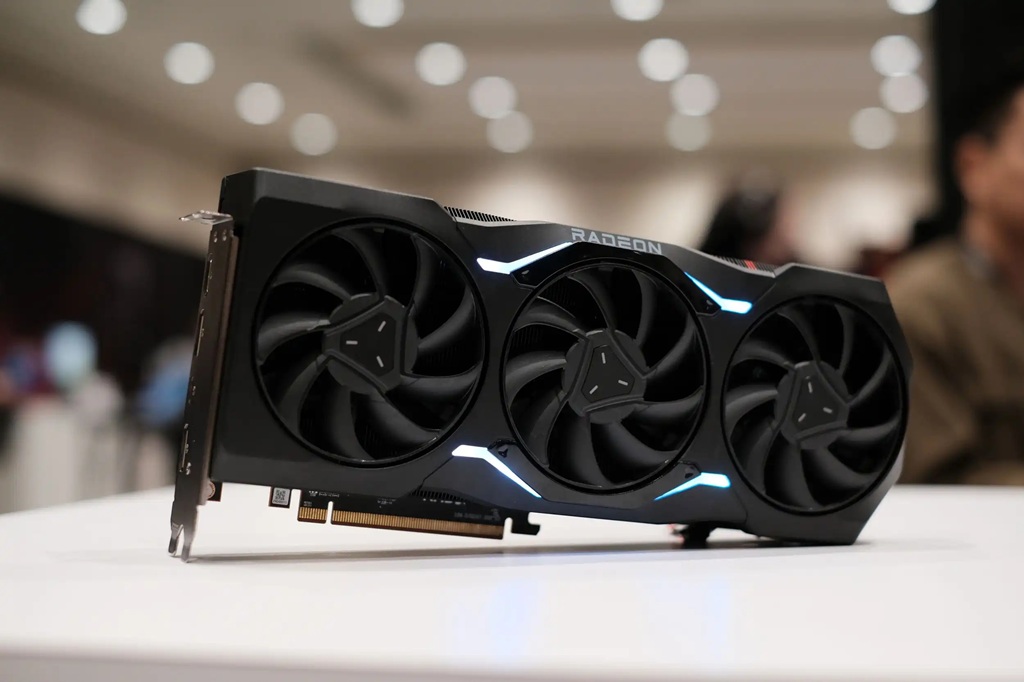
The AMD Radeon RX 7900 XTX launched as a flagship contender, aiming squarely at the high-end gaming market. Built on the innovative RDNA 3 architecture, it promised stellar performance, particularly in traditional rasterization, often going toe-to-toe or even surpassing rivals like NVIDIA’s GeForce RTX 4080 in raw pixel-pushing power. But in the increasingly demanding world of ray-traced gaming, how does AMD’s champion fare? Does it bask in the glory of realistic lighting, or does the performance cost cast too long a shadow? Let’s dive deep into the ray tracing capabilities of the RX 7900 XTX.
What Exactly is Ray Tracing?
Before we assess the RX 7900 XTX’s performance, let’s quickly demystify ray tracing. Think of it as a sophisticated way games render light. Instead of using older techniques (rasterization) that approximate how light behaves, ray tracing simulates the actual path of light rays as they bounce around a scene. This allows for incredibly realistic reflections that mirror the environment accurately, shadows that soften or sharpen naturally based on light sources, and global illumination that captures how light subtly bounces off surfaces to illuminate others. The result? A significant leap in visual fidelity and immersion, making virtual worlds feel more tangible and lifelike. However, this realism comes at a cost – simulating potentially billions of light paths in real-time is computationally very expensive.
AMD Radeon RX 7900 XTX: RDNA 3 Muscle
The RX 7900 XTX is the pinnacle of AMD’s RDNA 3 architecture for consumers. Key features contributing to its performance include:
- Chiplet Design: A first for consumer GPUs, separating the main Graphics Compute Die (GCD) from Memory Cache Dies (MCDs), allowing for optimized manufacturing processes.
- Compute Units (CUs): 96 advanced RDNA 3 CUs, featuring architectural improvements over RDNA 2.
- Stream Processors: A total of 6144 stream processors handle the bulk of the graphical workload.
- Second-Generation Ray Accelerators: Each CU houses a dedicated Ray Accelerator (RA), designed to speed up the complex calculations needed for ray tracing intersection tests. RDNA 3 aimed to improve throughput and efficiency here compared to RDNA 2.
- Infinity Cache: 96MB of AMD’s high-speed L3 cache helps feed the GPU and reduce memory bottlenecks.
- VRAM: A generous 24GB of GDDR6 memory on a wide 384-bit bus provides ample capacity for high-resolution textures and complex scenes.
These specs position the RX 7900 XTX as a formidable card, especially strong in 4K rasterization performance where it often competes favorably with the NVIDIA GeForce RTX 4080 and even the RTX 4080 Super.
Ray Tracing Performance: The Reality Check
When ray tracing enters the picture, the performance landscape shifts. Activating these demanding effects invariably leads to a significant drop in frame rates on any GPU, but the magnitude of this drop is where comparisons become crucial.
Compared to its excellent rasterization performance, the RX 7900 XTX takes a considerable hit when enabling ray tracing. While AMD made strides with its second-generation Ray Accelerators in RDNA 3, improving efficiency and throughput over the RX 6000 series, it still generally lags behind NVIDIA’s contemporary offerings (RTX 40 series and the newer RTX 50 series).
Benchmark data and reviews consistently show that cards like the RTX 4080, RTX 4080 Super, and RTX 4090 maintain a noticeable lead over the RX 7900 XTX in ray-traced scenarios. This gap widens significantly in games with heavy ray tracing implementations or full path tracing (like Cyberpunk 2077’s Overdrive mode or Minecraft RTX). Depending on the game, resolution, and specific ray tracing settings, the NVIDIA counterparts can be anywhere from 15% to over 35% faster, sometimes even more in extreme cases.
However, this doesn’t mean the RX 7900 XTX can’t handle ray tracing. In many titles, particularly those with lighter or more optimized RT implementations (like Resident Evil 4, Doom Eternal, or games ported from consoles with RT features), the card can deliver playable, even smooth, frame rates, especially at 1440p resolution. At 4K, achieving a consistent 60 FPS often requires compromises, either by lowering RT settings or employing upscaling technology.
Related: How to Fix Corrupted Firmware on PS4: A Comprehensive Guide
Factors Influencing Ray Tracing Performance
Several elements determine how well the RX 7900 XTX performs with ray tracing enabled:
- Game Implementation: How efficiently developers integrate ray tracing effects significantly impacts performance. Some games use RT for subtle enhancements (ambient occlusion, specific shadows), while others go all-in with global illumination, multiple reflection bounces, and more, hitting performance harder.
- Intensity of Effects: Turning on every available RT feature (reflections, shadows, global illumination) simultaneously will naturally be more demanding than enabling just one or two.
- Resolution: Ray tracing calculations scale with resolution. Running at 4K is significantly more demanding than 1440p or 1080p.
- AMD FidelityFX Super Resolution (FSR): This is AMD’s answer to NVIDIA’s DLSS and is critical for a good ray tracing experience on the RX 7900 XTX in demanding titles. FSR renders the game at a lower internal resolution and then uses sophisticated algorithms to upscale the image to the target resolution (e.g., 1440p or 4K). This dramatically reduces the rendering load, boosting frame rates significantly. FSR 2 offered good quality, FSR 3 added Frame Generation (AMD Fluid Motion Frames – AFMF) for even higher FPS (though sometimes with added latency or artifacts), and the latest FSR 4 utilizes AI acceleration aiming for further image quality improvements. The availability and quality of FSR (especially FSR 2/3/4 vs the older FSR 1) in a specific game heavily influence the viability of using ray tracing.
Is the RX 7900 XTX Good Enough for Ray Tracing?
The answer is nuanced: Yes, but with caveats.
The RX 7900 XTX is undoubtedly capable of running games with ray tracing enabled. It represents a significant improvement over AMD’s previous generation. In many modern titles, especially using FSR on “Quality” or “Balanced” modes, you can enjoy ray-traced visuals at 1440p or even 4K with playable frame rates (often 60 FPS or close to it). Games like Resident Evil 4, Spider-Man Remastered/Miles Morales, Dying Light 2, and even Cyberpunk 2077 (with medium RT settings and FSR) can provide a visually enhanced and smooth experience.
However, if your primary goal is to experience ray tracing at its absolute maximum settings in the most demanding titles (like Alan Wake 2 or Cyberpunk 2077 with Path Tracing) without making significant compromises, the RX 7900 XTX shows its limitations compared to NVIDIA’s high-end offerings. The performance deficit in these heavy RT workloads is undeniable, and NVIDIA’s DLSS (particularly DLSS 3/3.5 with Frame Generation and Ray Reconstruction) often provides a more mature and performant solution in these specific scenarios.
Ultimately, the RX 7900 XTX is a fantastic high-performance GPU that excels at traditional rasterization. It adds respectable ray tracing capabilities to its repertoire, making it a viable option for gamers who want great overall performance and want to dabble in or regularly use ray tracing, especially when paired with FSR.
Related: Which NAT is Better for Gaming? A Comprehensive Guide
People Also Ask (FAQs)
Q1: How does the RX 7900 XTX compare to the RTX 4080 (or 4080 Super) in ray tracing?
A1: The RTX 4080 and 4080 Super are generally faster in ray tracing workloads, often by a margin of 25-35% or more on average, depending on the game and settings. The gap increases in titles with very heavy ray tracing or path tracing.
Q2: Does FSR significantly improve ray tracing performance on the RX 7900 XTX?
A2: Yes, absolutely. FSR (especially FSR 2 and newer versions) is often essential to achieve smooth frame rates (60+ FPS) with ray tracing enabled at higher resolutions like 1440p and 4K on the RX 7900 XTX. FSR 3/4 with Frame Generation can provide even larger FPS boosts.
Q3: What popular games run well with ray tracing on the RX 7900 XTX?
A3: Games with more optimized or less intensive RT effects tend to run well, especially with FSR. Examples include Resident Evil 4 Remake, Doom Eternal, Marvel’s Spider-Man Remastered, Dying Light 2, The Witcher 3 (with moderate RT settings), GTA V Enhanced, and Avatar: Frontiers of Pandora.
Q4: Is the ray tracing performance difference between AMD and NVIDIA noticeable during gameplay?
A4: It can be. While the RX 7900 XTX provides playable RT experiences in many games, the higher performance of comparable NVIDIA cards might allow for higher RT settings, higher resolutions, or higher frame rates, which can be noticeable. In extremely demanding path-traced games, the difference can be stark, potentially making the experience unplayable on the AMD card while remaining viable on the NVIDIA equivalent thanks to technologies like DLSS 3.5.
Q5: Is the RX 7900 XTX worth buying if I care about ray tracing?
A5: It depends on your priorities and budget. If you want the absolute best ray tracing performance available, NVIDIA’s high-end cards (RTX 4080 Super, 4090, or the 50 series) hold the advantage. However, if you want a powerful card with excellent rasterization performance that is also capable of delivering good ray tracing experiences (especially with FSR) and often comes at a more competitive price point, the RX 7900 XTX is a very strong contender and worth considering.
Conclusion
The AMD Radeon RX 7900 XTX stands as a testament to AMD’s progress in the GPU space. It’s a rasterization beast, delivering flagship-level performance that challenges the competition head-on. When it comes to ray tracing, it’s a capable performer, marking a significant generational leap for AMD. While it doesn’t dethrone NVIDIA in pure RT throughput, especially in the most demanding scenarios, it brings playable and visually impressive ray-traced experiences to the table for many games, particularly when leveraging the power of FSR. For gamers seeking a high-end card with fantastic overall performance and competent ray tracing capabilities, often at a better value proposition, the RX 7900 XTX remains a compelling choice in 2025. Just be prepared to lean on FSR to make the most of those beautiful, realistic reflections and shadows in more demanding titles.


