

The sun beams down an incredible amount of energy every single day, far more than humanity consumes. Harnessing this power efficiently and affordably is key to a sustainable future. For decades, silicon-based solar panels have been the workhorse of residential solar energy, converting sunlight into electricity on countless rooftops. But science is always pushing boundaries, searching for ways to squeeze even more power from those rays. Enter quantum dots (QDs) – microscopic marvels that promise a potential revolution in solar technology, possibly boosting efficiency and changing the way we power our homes.
While the idea sounds futuristic, the potential is real. But can these tiny particles truly make a difference for the average homeowner? Let’s dive into the world of quantum dots and see if they’re poised to make the leap from the lab to your roof.
What Exactly Are Quantum Dots?
Imagine semiconductor crystals shrunk down to nanoscopic sizes, typically just a few nanometers across – thousands of times smaller than the width of a human hair. These aren’t just tiny specks; at this minuscule scale, they operate under the strange and wonderful rules of quantum mechanics, earning them the nickname “artificial atoms.”
What makes quantum dots truly special for solar applications is their unique relationship between size and light absorption. Unlike bulk materials like silicon, which have a fixed bandgap (determining the energy, or color, of light they can absorb best), the bandgap of a quantum dot can be precisely tuned simply by changing its size. Smaller dots absorb higher-energy light (like blue and UV), while larger dots absorb lower-energy light (like red and infrared). This tunability is a game-changer because it opens the door to designing solar cells that can capture a much broader range of the sunlight hitting them.
How Can Quantum Dots Boost Solar Panel Efficiency?
Traditional silicon solar panels are great, but they have limitations. They are most efficient at converting specific wavelengths of light and struggle to utilize the full solar spectrum, especially lower-energy infrared light which accounts for a significant portion of solar energy. They also generally produce one electron (the basis of electrical current) for each photon (particle of light) absorbed, regardless of the photon’s energy – higher energy photons simply waste their excess energy as heat. This is where quantum dots offer exciting possibilities:
-
Capturing More Sunlight:
Because their light absorption can be tuned by size, quantum dots can be engineered to capture wavelengths that silicon panels miss, particularly in the infrared part of the spectrum. Solar cells could potentially use layers of different-sized QDs, each optimized for a different slice of the solar spectrum, much like a multi-junction cell but potentially using the same base material. This “spectral tuning” means less wasted sunlight and more potential energy conversion.
-
Multiple Exciton Generation (MEG):
This is perhaps the most revolutionary potential of QDs. When a high-energy photon (like blue or UV light) strikes certain types of quantum dots, it can generate more than one electron-hole pair (exciton). Traditional cells waste the extra energy from these high-energy photons as heat, but MEG allows QDs to convert that excess energy into additional charge carriers. In theory, this phenomenon could dramatically increase the current produced and push solar cell efficiencies well beyond the ~33% theoretical limit (Shockley-Queisser limit) for single-junction silicon cells. Some theoretical models suggest QD-based cells utilizing MEG could reach efficiencies as high as 66%.
Researchers are actively translating this potential into reality. While early QD solar cells had efficiencies in the low single digits, recent breakthroughs, particularly using perovskite quantum dots (PQDs), have pushed lab records significantly. In early 2024, researchers at UNIST in South Korea reported a certified efficiency of 18.1% for their organic PQD solar cell, a notable jump achieved through innovative techniques to improve charge transport between the dots. While this is still below top-tier silicon panels (which often exceed 20-22% efficiency), it demonstrates rapid progress in the field.
Related: How Long Does It Take to Charge an Electric Car
The Journey from Lab to Rooftop: Challenges and Progress
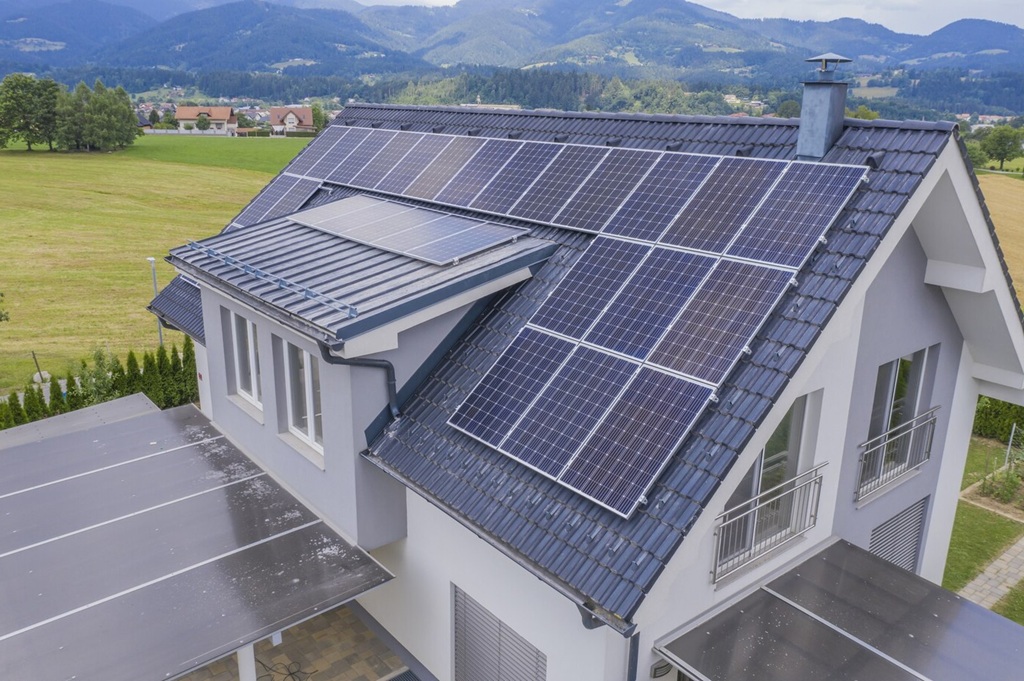
Despite the exciting potential and record-breaking lab results, quantum dot solar panels aren’t lining residential rooftops just yet. Several significant hurdles need to be overcome before they become a viable option for widespread home use:
-
Stability and Durability:
This is a major challenge. Many high-performing QD materials, especially organic and perovskite types, are sensitive to oxygen, moisture, and UV light, leading to degradation over time. While recent advancements (like the UNIST cell showing good stability after months/years of storage) are promising, achieving the 25-30 year lifespan expected from conventional silicon panels under real-world weather conditions requires further breakthroughs in materials science and encapsulation techniques.
-
Toxicity Concerns:
Some of the most efficient quantum dots developed so far rely on heavy metals like cadmium (Cd) and lead (Pb), which are toxic and pose environmental risks during manufacturing, use, and disposal. This is a significant concern for consumer products and large-scale deployment. Consequently, a lot of research focuses on developing efficient, stable, and non-toxic alternatives using materials like silicon, graphene, carbon, copper indium sulfide (CIS), indium phosphide (InP), or tin.
-
Scalability and Cost:
Current methods for synthesizing high-quality quantum dots are often complex and expensive, making them unsuitable for the massive scale required for the solar industry. Research shows current QD synthesis costs can be prohibitively high ($11-$73+ per gram), contributing significantly to potential module costs. Bringing down manufacturing costs through scalable processes (like roll-to-roll printing or improved chemical vapor deposition) is absolutely critical for QDs to compete with the mature and relatively low-cost silicon manufacturing infrastructure. A target cost of around $5 per gram has been suggested to move towards commercial viability.
-
Integration:
Researchers are exploring various ways to use QDs: as the primary light-absorbing material, in tandem structures layered with silicon or perovskite cells (where QDs capture different light wavelengths to boost overall efficiency), or even as specialized coatings or films applied to existing panel types. Finding the most effective and cost-efficient integration method is ongoing.
Are Quantum Dot Solar Panels Ready for Your Home?
As of mid-2025, dedicated quantum dot solar panels are not yet commercially available for typical residential rooftop installations. The technology is primarily still in the research and development phase, with ongoing efforts focused on tackling the challenges of efficiency, stability, cost, and scalability.
While some niche applications, like quantum dot-enhanced films for windows (e.g., from UbiQD) or prototypes exist, the leap to mass-market rooftop panels comparable to silicon in performance, lifespan, and price is likely still several years away, at best. The timeline depends heavily on breakthroughs in stable, non-toxic materials and cost-effective, large-scale manufacturing.
However, the potential benefits for homeowners, should these challenges be overcome, are substantial:
- Higher Efficiency: Generating more power from the same roof space.
- Potential for Lower Costs: If manufacturing can be scaled effectively, QD materials could eventually be cheaper than highly purified silicon.
- Flexibility: QDs can be made into inks and potentially printed onto flexible substrates, opening possibilities beyond rigid panels, perhaps for curved surfaces or integrated building materials.
- Lightweight: Potentially reducing structural requirements for roofs.
Related: The Best Ways of Heating Your Conservatory
People Also Ask (FAQs)
Q1: What is the maximum efficiency achieved by quantum dot solar cells so far?
A: The current certified record efficiency for a quantum dot solar cell achieved in a laboratory setting is 18.1%, reported by researchers at UNIST using organic perovskite quantum dots (as of early 2024). Theoretical efficiencies, especially utilizing effects like Multiple Exciton Generation (MEG), could potentially reach up to 66%.
Q2: Are quantum dot solar panels available for purchase now for homes?
A: No, not for standard rooftop installations. While the technology is advancing rapidly and some niche products might incorporate QDs, mainstream QD solar panels for residential use are not yet commercially available due to ongoing challenges in cost, stability, and manufacturing scale.
Q3: What are the main disadvantages of quantum dot solar cells currently?
A: The primary disadvantages hindering commercialization are: * Stability/Durability: Many QD materials degrade relatively quickly when exposed to environmental factors like air and moisture compared to silicon. * High Production Cost: Current synthesis and manufacturing methods are expensive and difficult to scale. * Toxicity: Many high-efficiency QDs contain toxic heavy metals like lead or cadmium, raising environmental concerns. Research into safer alternatives is ongoing. * Efficiency Gap: While improving, current lab efficiencies are still generally below commercially available silicon panels.
Q4: How much do quantum dot solar panels cost compared to silicon panels?
A: Since they are not yet commercially mass-produced, there’s no standard market price. However, current production costs for the QD materials themselves are very high compared to silicon materials, making potential QD panels significantly more expensive than current silicon panels. A major goal of ongoing research is to drastically reduce these manufacturing costs.
Q5: Are quantum dots toxic?
A: It depends on the material. Many of the most studied and efficient QDs contain cadmium (Cd) or lead (Pb), which are known toxic heavy metals. Exposure could pose risks if the dots decompose. However, there is significant research into developing non-toxic quantum dots made from materials like carbon, graphene, silicon, indium phosphide, or copper indium sulfide, which would be much safer for widespread use and disposal.
Conclusion: A Bright, Tiny Future on the Horizon
Quantum dots represent a fascinating and potentially transformative pathway toward more efficient solar energy generation. Their unique quantum properties offer theoretical advantages that could significantly outperform traditional silicon technology, potentially leading to cheaper, more flexible, and more powerful solar solutions for homes and beyond.
However, the journey from lab-scale breakthroughs to affordable, reliable rooftop panels is complex. Significant challenges in long-term stability, toxicity of common materials, and cost-effective mass production must be overcome. While you likely won’t be installing pure QD panels on your home next year, the pace of research is accelerating. Innovations in materials science and manufacturing techniques are continuously pushing the boundaries. Quantum dots might first appear commercially as efficiency-boosting layers or components within hybrid cells alongside silicon or perovskites.
For homeowners interested in solar, keeping an eye on quantum dot developments is worthwhile. They represent a key area of innovation that, within the next decade or so, could fundamentally improve the efficiency and economics of harnessing the sun’s power for our homes. The future of solar energy might just be incredibly small.

